Showing posts with label invasive plants. Show all posts

Friday, September 18, 2015

Invasive Aliens and Alien UFO

A splendid late summer view of the Pennypack Preserve meadows along the Meadow Crossing Trail
Former Pennypack Trust Stewardship Assistant Mike Coll moved on five years ago to become the land manager at a preserve owned by another land conservancy in our area.  I consider Mike a colleague, and I contacted him when Temple University (where I am an adjunct faculty member) needed an individual to teach a class on invasive organisms.  It was a match made in heaven (both for Mike and Temple), and Mike is now teaching the class for a second year.
Mike (second from right) holding forth on restoration strategies
On Thursday, September 17, Mike brought his students to Pennypack to examine invasive plants (no shortage of them here, unfortunately) and the Trust's restoration projects.  I spent the morning accompanying the class as we walked about three miles through the preserve.
Handling (carefully!) an American chestnut burr
One of our stops was a reforestation area planted in 1994 adjacent to Papermill Woods.  We incorporated a few pure American chestnut trees into the reforestation project, and now the trees are 30 feet tall and producing fruits (more appropriately called burrs).  The trees are all infected with the non-native chestnut blight fungus, but they are pumping out burrs like crazy nonetheless.  The burrs are really prickly and painful to hold; I don't know how squirrels manage to get them open.
Preparing for liftoff
After the walk, Mike brought out his drone to show the students how these devices can be useful for examining the landscape from the air.  He flew the drone about one mile away and returned it to the launch site, a tour that took 9 minutes.  The drone has the capacity to fly for about 18 minutes on one battery charge.
UFO spotted over the preserve
Mike remotely piloted the drone to fly over the meadows and woodlands of the preserve, and then to circle the Bryn Athyn Cathedral (the right tower in the image above, one mile distant).  All the while, the drone was sending back remarkably clear video that Mike recorded on his iPad.  He promised to share the video with me; if he does so, I will post it later.

Submitted by David Robertson
Executive Director

Tuesday, July 21, 2015

Wait! Wait! Don't Pull Me!


Have you ever seen a vine creeping up on a shrub or tree and thought, “Oh, no you don’t! YANK!” That’s good, right?  Not necessarily. I’m Josh Bruce, a Biology major from Vassar College and long-term resident of the greater Philadelphia area.  As a research intern at the Pennypack Trust this summer I am studying the possibility of unintended environmental damage from well-meaning management practices.
Although invasive vines have become an incredibly destructive force on the East Coast—toppling thousands of acres of forests from the edges inward—combating them with brute force may not be the best strategy. In fact, tearing vines out could lead to greater environmental damage than stability in the long term: tree limbs can be accidentally broken, invasive seeds may be spread, and, most importantly, the forest floor can become disturbed.  Uprooting the shallow root networks of invasive vines largely also clears the ground layer of any plants and tree seedlings that are entangled in the invasive plants' roots, leaving bare patches and, even worse, furrows of loose earth like a tilled garden ready for new seed.

Unfortunately this blank space will either be eroded away or filled by whatever can get there first. Since the area was previously invaded, seeds of that very same invasive plant are likely already in the soil. If the original invasive species doesn’t re-invade, hosts of other invasive species have a chance, and a management area can quickly become a foothold for secondary invasion. The initial invader may have had to contend with a thick layer of dead leaves and a diverse community of native plants when it first tried to invade; the newly "managed" site is left with neither of these defenses; therefore, a secondary invasion will likely be even denser and more successful at suppressing native plant regeneration than the initial invasion.
 With my research this summer I am specifically focusing on Oriental bittersweet (Celastrus orbiculatus). This invasive vine, though hard to pull from trees and shrubs, is relatively easy to pull from the soil, making uprooting a tempting management strategy. I have used a 2-meter-wide, custom designed plot frame (a loop of PVC plumbing pipe) to survey the ground cover vegetation in bittersweet-dense areas in the Pennypack Preserve. This gives me a baseline idea of what an initial bittersweet invasion may look like. Following my survey, I either (1) leave the plot alone, (2) cut the bittersweet stems where they emerge from the ground and clip away as much of the top as possible, or (3) rip all traces of Oriental bittersweet from the plot, along with anything else it might have tangled-up in it.
Next year and for several years thereafter, I (or another young scientist) can go back to these plots, survey what has grown or regrown, and repeat the treatments. After several years I hope to be able to say with confidence whether we should or should not use uprooting as a management strategy for Oriental bittersweet, whether clipping the stems year after year is enough to suitably quell an invasion, and what kind of plants are likely to grow in place of Oriental bittersweet that has been ripped or cut. Until then, cutting and carefully removing the top of invasive vines while leaving the roots intact is the safest, if not the most efficient, way to go.
Submitted by:
Joshua Bruce, Research Intern

Thursday, July 17, 2014

Summer Snowstorm

Look carefully for the "snowflakes" against the dark trees in the background
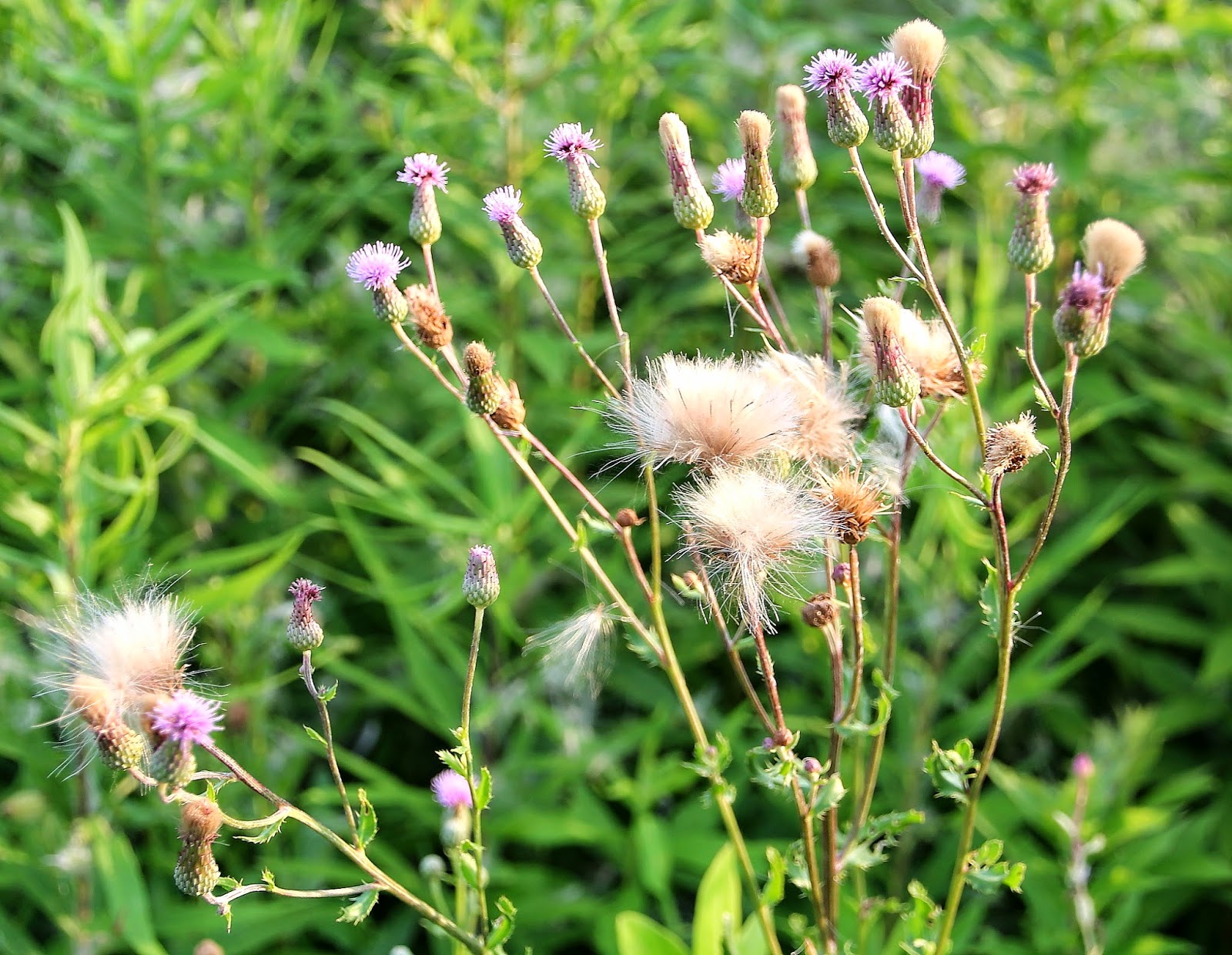
We're experiencing a "snowstorm" in the Pennypack Preserve this month.  Non-native Canada thistle (Cirsium arvense) (a real misnomer and a "slight" to Canada since this thistle is actually a native of Eurasia) has exploded in our grasslands.
The culprit in flower
All stages -  from flower to fluff
The incredible infestation is the result of a perfect storm of unfortunate events.  First, our boom sprayer was out of commission in the spring so Chris Dartley, our grassland manager, couldn't spray the thistle when it was most susceptible.  Second, the herbicide we've been using to try to control the thistle, Transline, seems to be losing its effectiveness, so we're going to have to find an alternative.  And third, by the time we realized the mess we were going to be in, migratory birds and rabbits had begun to nest in the fields, so we couldn't mow the thistle to prevent it from going to seed.
A patch with countless seeds
Non-native wineberry (Rubus phoenicolasis) cloaked in thistledown
Everything in the fields that's not green is thistle
One silver lining to these thistledown clouds: the American Goldfinches (Carduelis tristis) are having a field day (so to speak) feasting on the abundance.

Tuesday, February 11, 2014

Down to Seeds and Stems

We've had generous numbers of American Robins (Turdus migratorius) around the Pennypack Preserve all winter.  There are always robins here during the winter, but we seem to have more than the typical number this winter - despite the fact that there's more snow and longer-lasting snow cover than usual.

Because the snow has lasted so long, I (and other birders) have been wondering what the robins have been eating.  Though they are insectivores and carnivores during the growing season, they rely on fruits and berries during the winter.  However, they long ago stripped all the crabapple trees and holly shrubs of their berries.  What's left?

When Mary and I took a walk on Sunday afternoon, I noticed a small group of robins perched in a tree, flitting from branch to branch.  When I pulled up my camera with the telephoto lens, it became clear what was happening: the robins were eating fruits of invasive alien Asian bittersweet.

I knew that robins ate bittersweet arils (along with the berries of invasive Japanese honeysuckle and the hips of alien multiflora rose), which helps to spread the plants, but this is the first time I had seen them in action.  In addition, one of our strategies for managing our preserve is to try to eliminate as many of these alien plants as possible, so I feel a little guilty about reducing the winter birds' food sources.  On the other hand, the birds can always seek food in warmer climes, can't they...
The image above depicts an Eastern Bluebird (Sialia sialis) nesting box adorned with an icicle.  Bluebirds, also thrushes like robins, switch their diet in winter, too, and we host many bluebirds in the preserve as well.
 
Submitted by
David Robertson, Executive Director 

Tuesday, January 21, 2014

Day of Service to the Forest

 
For the second year in a row, the Pennypack Trust sponsored a Day of Service on the Martin Luther King, Jr. holiday.  Like they did last year, the 15 volunteers who came out to work readied an area for reforestation in the spring by gathering large woody debris into a central location.  The volunteers concentrated their efforts in the wooded 5-acre tract immediately adjacent to the Trust's headquarters on Edge Hill Road.
Woody debris is important in the forest ecosystem, but our degraded woodlands are under siege by invasive plants, and the branches, limbs and logs on the forest floor prevent the land stewardship staff from gaining access to new planting sites.  New plantings need to be kept clear of non-native plants - especially vines.
The former owner of this land planted non-native pachysandra; it's visible in the background as a green "blanket"
So, we've weighed our management options and have made the decision to remove the maintenance obstacles.
Besides, there's always more wood falling from the canopy as the mature trees shed limbs and topple over during storms.  The forest floor won't remain "clear" for long.

Submitted by David Robertson
Executive  Director

Tuesday, October 1, 2013

Surrounded, but No Surrender!

Porcelain-berry, the "kudzu of the North," on the periphery of the Pennypack Preserve
For some reason (perfect temperatures, soil moisture, carbon dioxide concentrations, or a synergistic interaction of all three), the invasive Asian vine porcelain-berry (Ampelopsis brevipedunculata) "exploded" in the Pennypack Preserve this summer.  The perennial vine is ever present, and always the biggest threat in the natural area.  When I began my job here 25 years ago, one of the first tasks I set for myself was to bring the plant under control in the most heavily infested areas, and I was really able to knock it back with several years' intensive mechanical and chemical control efforts.  But, as I said, this year it has re-surged with a vengeance. 
Porcelain-berry fruits in varying stages of ripeness
Porcelain-berry was introduced to the united States from eastern Asia, probably as a garden ornamental.  It's fruits are attractive for about two weeks in the fall, but the rest of the year the plant just looks like a sprawling grapevine - to which it is very closely related.

Once the plant escaped the bounds of gardens (undoubtedly aided by birds that eat its fruit and then defecate the seeds elsewhere), it found a perfect home in the Mid-Atlantic.  It grows up into the canopy, spreads out to capture sunlight, and blankets the trees supporting it, eventually shading the trees to death or ripping off their limbs when the weight of the vines becomes too much for the tree to bear, especially when covered in snow and ice in the winter.
Porcelain-berry flowers attracting a honeybee
Porcelain-berry is served by generalized pollinators, so it is not dependent on a specialized bee, wasp or bat to spread its pollen.  And, while it's an introduced species, our native North American songbirds (and white-tailed deer) consume it readily, helping to spread the plant across the landscape, probably because it is so closely related to the grapes that are already familiar to our native species.

The only insects I have ever observed damaging porcelain-berry leaves are invasive, non-native Japanese beetles, but they never become numerous enough to inflict real harm to the plant.  I suspect that even if the plant has a specific disease or insect pest that keeps it in check in its East Asian homeland, such a disease or insect could never be imported into the United States as a biocontrol agent because it likely would also attack commercial grapes.
A porcelain-berry rhizome
Porcelain-berry develops an extensive, thick underground stem or rhizome.  The rhizome grows through the soil and sends up shoots ever few feet or so.  An infestation of porcelain-berry may actually consist of only a few plants all growing from the same underground stems.  Cutting off a few of the above-ground vines hardly fazes the plant, which has plenty of resources stored underground.  The only feasible method of control is to poison the plant with a broad-leaf herbicide applied either to the foliage or directly onto the rhizome after an above-ground stem is severed.
One of Pennypack's board members asked me to do a photographic inventory of land parcels on the periphery of the preserve that we might be able to acquire to add to the natural area.  I completed the inventory and prepared a PowerPoint program that I presented at the last board meeting.  In my remarks prefacing the presentation, I alerted the board members to note that every single one of the parcels I had photographed that was not maintained as a meadow or as lawn was completely overwhelmed by porcelain-berry.  Even if we got the plant under control within the preserve, the Vandals are at the gates on private properties we can't touch.


But we do have a chance to maintain the natural diversity inside the preserve, and we will redouble our efforts to try to bring porcelain-berry under control or the winter and during the next growing season.

Submitted by
David Robertson, Executive Director