Friday, September 18, 2015

Invasive Aliens and Alien UFO

A splendid late summer view of the Pennypack Preserve meadows along the Meadow Crossing Trail
Former Pennypack Trust Stewardship Assistant Mike Coll moved on five years ago to become the land manager at a preserve owned by another land conservancy in our area.  I consider Mike a colleague, and I contacted him when Temple University (where I am an adjunct faculty member) needed an individual to teach a class on invasive organisms.  It was a match made in heaven (both for Mike and Temple), and Mike is now teaching the class for a second year.
Mike (second from right) holding forth on restoration strategies
On Thursday, September 17, Mike brought his students to Pennypack to examine invasive plants (no shortage of them here, unfortunately) and the Trust's restoration projects.  I spent the morning accompanying the class as we walked about three miles through the preserve.
Handling (carefully!) an American chestnut burr
One of our stops was a reforestation area planted in 1994 adjacent to Papermill Woods.  We incorporated a few pure American chestnut trees into the reforestation project, and now the trees are 30 feet tall and producing fruits (more appropriately called burrs).  The trees are all infected with the non-native chestnut blight fungus, but they are pumping out burrs like crazy nonetheless.  The burrs are really prickly and painful to hold; I don't know how squirrels manage to get them open.
Preparing for liftoff
After the walk, Mike brought out his drone to show the students how these devices can be useful for examining the landscape from the air.  He flew the drone about one mile away and returned it to the launch site, a tour that took 9 minutes.  The drone has the capacity to fly for about 18 minutes on one battery charge.
UFO spotted over the preserve
Mike remotely piloted the drone to fly over the meadows and woodlands of the preserve, and then to circle the Bryn Athyn Cathedral (the right tower in the image above, one mile distant).  All the while, the drone was sending back remarkably clear video that Mike recorded on his iPad.  He promised to share the video with me; if he does so, I will post it later.

Submitted by David Robertson
Executive Director

Tuesday, September 1, 2015

Late Summer Dusk

At dusk every evening in late summer, hundreds - maybe thousands - of American Robins fly over the Raytharn Farm fields.  Almost all are flying from north to south, though I don't think they are migrating.  I believe they are headed to a communal roost somewhere beyond the horizon.  This astonishing passage can continue for half an hour, with birds materializing out of thin air in the north and then fading into the ether to the south.

Sometimes the birds are clumped together.  Sometimes, they are flying solo.  Usually, though, they are flying in small groups.  All pass silently overhead, earnest to get to their destination before nightfall.  I can watch, mesmerized, for the entire spectacle.  My poor wife Mary, whose eyesight is nowhere as good as mine and who has lots of "floaters," only sees the occasional bird and doesn't understand my open-mouthed astonishment.  
Curiosity overpowering the instinct to flee
Last evening, I went out to see if any Common Nighthawks were migrating over Raytharn Farm.  Mary and I watched nine of them wheeling over the meadows on Sunday evening, August 23, but I haven't seen any since.  Because their migration is a harbinger of autumn, and nighthawks are fascinating birds in their own right, I'm always excited to see them, but was only fortunate once this summer.  Instead, last night I was treated to several does and their fawns browsing in the meadows and...
Heading back to the evening roost
...a small flock of tom turkeys sauntering through the grasses, reluctant to end their day.
Foxtail
This spring, our native grasslands were infested with Canada thistle, a Pennsylvania noxious weed that we are obligated by law to control (and which we want to manage in order to minimize competition with native grasses and desirable forbs).  We hired an herbicide professional to treat our fields, and his chemical magic did the trick - we had no thistle problem this year.  Instead, the fields are now a sea of non-native foxtail (Setaria spp.), an annual grass that is common in disturbed areas.  Once the native grasses regain the upper hand, foxtail will gradually disappear.
Foxtail seedhead
Dusk landscape with fields, forest, and distant towers in Bryn Athyn
The passing of summer does have its moments.
 
Submitted by
David Robertson, Executive Director 

Monday, August 10, 2015

Suburban Stormwater Tour: The Good, the Bad, and the Ugly

Los Angeles River East
The Pennypack Trust is partnered with four other watershed organizations in the Philadelphia suburbs in a consortium that is working to improve water quality and reduce stormwater quantity in the Delaware River.  Our consortium works in the Philadelphia suburbs, but the William Penn Foundation who spearheaded this work is funding seven similar consortia throughout the huge watershed.  Our consortium is tasked specifically with reducing stormwater, while the consortia working in less-developed parts of the basin are working to reduce agricultural impacts and to preserve open space.  The entire basin-wide project is called the Delaware River Watershed Initiative.

Our work has been going on for 1-1/2 years now, and the staff of the foundation requested a tour of sites where the foundation's support has been used to implement stormwater management projects in the field.  On Thursday, August 6, the watershed organizations' and foundation's staff members gathered for a day-long bus tour of four sites scattered throughout the Philadelphia suburbs.    

First stop was at a private residence in Haverford, Delaware County where a rain garden had been installed.  This rain garden was one of about 20 rain gardens that are being installed in prominent locations where neighbors and passers-by can become familiar with using a rain gardens to capture and infiltrate stormwater running off impervious surfaces instead of allowing it to pour directly into storm drains.
Publicity in the front yard
The rain garden, planted in May
Homeowner (blue shorts) and project consultants (right)
Second stop was a detention basin created to manage the stormwater for a 40-unit subdivision in Whitpain Township, Montgomery County.  While the basin was larger than needed to manage the stormwater generated by the subdivision, the basin was poorly designed and actually did almost nothing to detain stormwater.  The municipality has committed to modifying the basin by reducing the diameter of the discharge pipe (thus trapping and holding the stormwater for longer periods of time), creating islands, peninsulas, and pools within the basin to create habitat, and planting native vegetation throughout.
On the berm above the basin (about 10 feet deep)
Temple University hydrologist Lora Toran explaining testing equipment to monitor project effectiveness
After lunch, we toured a municipal sports complex in Horsham, Montgomery County where stormwater sheets off playing fields.  (Turf sheds water almost as effectively as asphalt.)  At this location, the municipality intends to create deep, rock-filled swales planted with native grasses or plastic igloo-like underground voids that will allow rainwater running off the fields an opportunity to soak into the ground rather than run off to the adjacent creek.
Water from the playing fields (right) and parking lot pours into this swale, then directly into a creek
Grass swale will be replaced with a rock-filled infiltration trench
Later in the afternoon, we stopped at one of the most challenging and intractable sites imaginable; we wanted to show the foundation staff members just what our organizations have to deal with in the developed suburbs.  Here in Abington, Montgomery County, the headwaters of Sandy Run drain a fully-developed residential and retail neighborhood.  Because the watershed has so much impervious surface (e.g., driveways, rooftops, lawns, and roads), very little rain water soaks into the ground, so the stream has almost no baseflow during dry periods.  However, when it rains, Sandy Run turns into a raging torrent because all of the imperious surfaces shed water directly to the creek.  Unfortunately, this neighborhood is densely developed, so the stream channel is located in residents' backyards and there's nothing that can be done to widen the channel or create stormwater detention.  Instead, Abington confined the creek to a concrete channel reminiscent of the infamous Los Angeles River to sluice the water downstream as quickly and "safely" as possible. 
Concrete confines
During Hurricane Floyd, two people living downstream of this channel drowned in their basement when the water rose up in a flash and flooded the house.  So much for safety.
 
Stormwater management is a difficult problem to address.  It took us literally centuries to for our urbanized watersheds to become like are in today.  Let's hope it doesn't take as long to correct the mistakes of the past. 

Tuesday, July 28, 2015

Headwaters Protection

Playground to be replaced with a rain garden
The Pennypack Trust is one of 80 watershed-protection organizations in the Delaware River basin that are participating in an ambitious collaborative effort called the Delaware River Watershed initiative funded by the William Penn Foundation to preserve and restore water quality in the Delaware River.

While the Pennypack Trust has not yet undertaken any projects in the Pennypack watershed, our sister organization, the Tookany-Tacony-Frankford Watershed Partnership (TTF) is going gangbusters on a small, heavily urbanized stream located just over the divide from the Pennypack watershed.

The stream, Jenkintown Creek, rises in a play area on the grounds of Abington Friends School.  The school is very interested in improving water quality in this small headwaters stream - both to be a good citizen, and also to use the restoration work as an educational resource for its students. On July 23, several of the local watershed organizations partnering in this collaborative effort took a tour of the work that has been completed on the school's property.

In the image at the beginning of this post, my friend and colleague Julie Slavet, director of the TTF, explained that the school is going to replace the existing grassy playground - the very beginning of the stream - with a rain garden that will capture runoff and allow it to percolate into the soil.
Newly planted riparian buffer.  The stream is flowing down the center between deer exclosures.
Just below the existing playground, the school has created 50-foot-wide riparian buffer plantings to shade and filter the nascent stream.
De-vine buffer
A bit downstream of the newly planted riparian buffer, the stream flows through existing streamside woodlands.  However, like all woodlands in the urbanized northern Piedmont (including the Pennypack Preserve), these trees were cloaked with invasive non-native vines.  The school's contractor removed the vines and planted individual trees in the areas freed of invasives.
Existing riparian buffer cleared of vines and expanded with new plantings
At the edge of playing fields
The soccer fields to the right of the image above shed precipitation almost as effectively as asphalt.  The school plans to create an infiltration trench at the base of the hill where the visitors are standing to capture the water coming off the fields and allow it to percolate into the ground rather than run directly into the stream to the left.
Parking lot runoff
The last stormwater management structure at the school will be a rain garden built at the end of the parking lot shown in the image above.  Now, when it rains, all of the water from the parking lot pours into the stream through the rocky gully visible in the image.  The school plans to capture the water in another rain garden and allow it to filter into the soil slowly.

Obviously, to make a difference in the overall Delaware River watershed, these types of projects will have to be repeated thousands of times over on countless small tributary streams.  But this is a great first step, and it serves as a model for others to emulate. 

Tuesday, July 21, 2015

Wait! Wait! Don't Pull Me!


Have you ever seen a vine creeping up on a shrub or tree and thought, “Oh, no you don’t! YANK!” That’s good, right?  Not necessarily. I’m Josh Bruce, a Biology major from Vassar College and long-term resident of the greater Philadelphia area.  As a research intern at the Pennypack Trust this summer I am studying the possibility of unintended environmental damage from well-meaning management practices.
Although invasive vines have become an incredibly destructive force on the East Coast—toppling thousands of acres of forests from the edges inward—combating them with brute force may not be the best strategy. In fact, tearing vines out could lead to greater environmental damage than stability in the long term: tree limbs can be accidentally broken, invasive seeds may be spread, and, most importantly, the forest floor can become disturbed.  Uprooting the shallow root networks of invasive vines largely also clears the ground layer of any plants and tree seedlings that are entangled in the invasive plants' roots, leaving bare patches and, even worse, furrows of loose earth like a tilled garden ready for new seed.

Unfortunately this blank space will either be eroded away or filled by whatever can get there first. Since the area was previously invaded, seeds of that very same invasive plant are likely already in the soil. If the original invasive species doesn’t re-invade, hosts of other invasive species have a chance, and a management area can quickly become a foothold for secondary invasion. The initial invader may have had to contend with a thick layer of dead leaves and a diverse community of native plants when it first tried to invade; the newly "managed" site is left with neither of these defenses; therefore, a secondary invasion will likely be even denser and more successful at suppressing native plant regeneration than the initial invasion.
 With my research this summer I am specifically focusing on Oriental bittersweet (Celastrus orbiculatus). This invasive vine, though hard to pull from trees and shrubs, is relatively easy to pull from the soil, making uprooting a tempting management strategy. I have used a 2-meter-wide, custom designed plot frame (a loop of PVC plumbing pipe) to survey the ground cover vegetation in bittersweet-dense areas in the Pennypack Preserve. This gives me a baseline idea of what an initial bittersweet invasion may look like. Following my survey, I either (1) leave the plot alone, (2) cut the bittersweet stems where they emerge from the ground and clip away as much of the top as possible, or (3) rip all traces of Oriental bittersweet from the plot, along with anything else it might have tangled-up in it.
Next year and for several years thereafter, I (or another young scientist) can go back to these plots, survey what has grown or regrown, and repeat the treatments. After several years I hope to be able to say with confidence whether we should or should not use uprooting as a management strategy for Oriental bittersweet, whether clipping the stems year after year is enough to suitably quell an invasion, and what kind of plants are likely to grow in place of Oriental bittersweet that has been ripped or cut. Until then, cutting and carefully removing the top of invasive vines while leaving the roots intact is the safest, if not the most efficient, way to go.
Submitted by:
Joshua Bruce, Research Intern

Friday, July 10, 2015

Foray to Frazier's Bog

Morton Arboretum's Joe Rothleutner's preparing an herbarium specimen
On Wednesday, July 8, I had the good fortune to escort two horticultural professionals to an amazing wetland located 0.3-mile from the Trust's headquarters - a forested swamp known as Frazier's Bog.

The swamp is not, in fact, a bog.  Bogs are characterized by standing water which is often stained tea-brown by tannins leached from decomposing organic matter.  In addition, bog water is acidic.  Frazier's Bog is actually a fen, which has running (albeit slowly running), clear water that tends to be neutral or slightly basic.  The water at Frazier's Bog seeps out of the porous quartizite bedrock Edge Hill Ridge immediately to the north, and the shallow rills, runnels, and rivulets that thread through the wetland flow over sandy beds.

The swamp is also amazing because it's a Coastal Plain outlier.  The Pennypack Preserve and environs are on the solid, metamorphic rocky Piedmont; the edge of the sandy Coastal Plain lies about 10 miles to the south.  Nevertheless, many of the the plants that occur in Frazier's Bog are plants typical of the Coastal Plain in New Jersey, not the Piedmont.  So, Frazier's bog is a rarit y- an island of the Coastal Plain 250 feet above sea level in a shallow basin in the Piedmont. 

The bog's unusual nature has been recognized for a century and a half, and over the years countless botanic field trips have tromped through the spongy, saturated site.  Currently, the wetland is located at the edge of the second fairway of Huntingdon Valley Country Club's C-golf course, but fortunately the country club recognizes the botanic gem and has posted signs to keep golfers out of the swamp (which is a treasure trove of lost golf balls).
Fortunately, the country club recognizes the wetland's value
Frazier's Bog (and and only two other sites in Pennsylvania) support sweetbay magnolia trees (Magnolia virginiana).  The Morton Arboretum in Lisle, Illinois and the Chicago Botanic Garden (CBG) have joined forces to create a sweetbay magnolia collection that includes specimens from the full range of the tree - Massachusetts to Cuba.  On Tuesday, Andrew Bunting of CBG and Joe Rothleutner of the Morton Arboretum came to Frazier's Bog to take softwood cuttings from 10 magnolias growing in the swamp.  They will attempt to root the specimens so they can be planted in the botanic gardens, and so that they can be propagated and shared with other gardens.  In addition, they are creating a germplasm "bank" in case the sites where these trees occur naturally are eliminated by hurricanes, tornadoes, fire or development. 
 Chicago Botanic Garden's Andrew Bunting "bagging" his quarry
The swamp floor is carpeted with skunk cabbage and ferns
In addition to taking the softwood cuttings, the pair collected specimens of the leaves and fruit from each of the sampled trees to include in an herbarium collection.
The Dynamic Duo just before leaving the swamp
After we left the swamp, we crossed to the opposite side of the fairway (fore!) to check on another Coastal Plain species, netted chain fern (Woodwardia areolata).
Joe photographing netted chain fern
When the country club resurrected this 9-hole course about 20 years ago (it had been "abandoned" during the Great Depression), they had enclosed the stand of ferns inside orange construction fencing.  The construction fencing is long gone and has been replaced with unobtrusive wire mesh fencing (which is collapsed and useless); the ferns, nonetheless, are thriving.
 
Submitted by
David Robertson, Executive Director

Dog Vomit Slime

Now that I've got your attention...
On the wood-chipped path outside my office
Of late, I'm obsessed with slime mold, and one species in particular: Fuligo septica.  Last year, a neighbor cut down several large tuliptrees that had grown too near his house.  His arborist chipped the wood, and Pennypack took the wood chips for our trails.  This spring, the wood chipped trail has come alive repeatedly with slime mold aggregations.

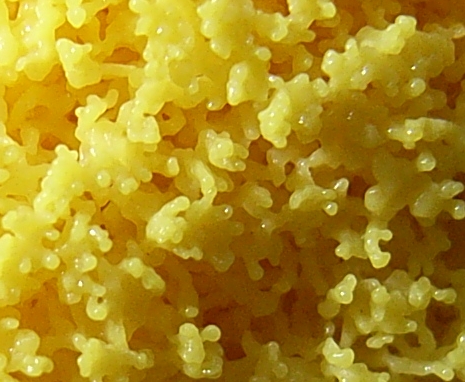
At first, this slime mold is a strikingly bright, brilliant yellow.

Image from Wikipedia
But after a day or so, it turns dun-colored and looks like its common name.

When I saw it, I knew this organism was a slime mold, but I knew very little about it, so I checked out the citation on Wikipedia and found out that Dog Vomit Slime (also known in more genteel circles as Scrambled Egg Slime [still not too appetizing] or Flowers of Tan) is one of the most common and widely distributed of the slime molds.

Slime molds are not molds (i.e., fungus) at all despite their common name. They and the other protists (i.e., single celled organisms) are lumped into their own kingdom equivalent to the animals, plants, and fungi, but the classification is constantly in flux because the relationships among these organisms are so poorly known and understood.
Like many slime molds, the cells of this species typically live independently, then based on some unknown cue, they come together and aggregate to form a plasmodium. Each cell gives up its individual existence and merges its cell body and nucleus into a mass that may move in an amoeba-like fashion in search of nutrients. F. septica's plasmodium may range from white to yellow-gray, and is typically 1-8 inches in diameter and 0.4–1.2 inches thick. The plasmodium eventually transforms into a sponge-like aethalium, analogous to the spore-bearing fruiting body of a mushroom, which then degrades, darkens in color, and releases its dark-colored spores. F. septica produces the largest aethalium of any slime mold.
Close-up image of the aethalium.  Soo cool!
In Estonian mythology, the aethalium was thought to be the leftovers from a kratt, a creature created by farmers out of hay and/or farm implements, given life by the devil after the farmer surrendered three drops of blood, and obligated to do the farmer's bidding. F. septica in Finland was believed to be used by witches to spoil their neighbors' milk. This gives it the name paranvoi, meaning "butter of the familiar spirit." In Flemish, it is known as "heksenboter," which refers to "witch's butter."
What strikes me as most odd is that none of the myriad visitors to the Trust's office who walk past the slime molds ever come in to inquire about them, especially when they're in their bright yellow stage.
 
Submitted by
David Robertson, Executive Director