Tuesday, September 23, 2014

Sora Out of Water

Sora (Porzana carolina) [Image from an Internet source]
This morning, two of Pennypack's best birders and nature photographers, Harris Brown and Fran Ventura, stopped in the office after a morning photo shoot to report that they had found and rescued a Sora (Porzana carolina) on a trail through the tall native grasslands on Raytharn Farm.  The Sora (a type of rail) was alive (though clearly injured or sick); Harris and Fran planned to take it to the Aark wildlife rehabilitation facility in Chalfont to see if it could be saved.

Two years ago, Pennypack birder Michael Grubb found a Sora on another of the Raytharn Farm grassland trails, but that bird was dead. 

I have no idea why a fairly uncommon bird almost always associated with marshes would be found high and dry in the prairie-like grasslands we have established in parts of the Pennypack Preserve.  Nor do I have any idea why these birds are in bad shape.  It's great that they're here, but not if the preserve is acting as a "sink" in which the birds fall victim to predators or disease.
 
Posted by David Robertson
Executive Director 

Thursday, August 28, 2014

Pennypack Trail Reconnoiter

Traversing a trestle spanning Pennypack Creek at Bethayres Woods
Visitors to the Pennypack Preserve know that the suspended Fox Chase-Newtown railroad right-of-way bisects the preserve, roughly paralleling Pennypack Creek that also bisects the preserve.  The rail line was built in 1876 with the intention of linking Philadelphia to New York City.  But a second rail line (the West Trenton line), built two years earlier in 1874, also with the intention of linking Philadelphia to New York City, had the advantage of traversing flatter terrain and allowing for greater speeds.  As a result, the 1874 line (built by the Pennsylvania Railroad) quickly won out, and the line through the Pennypack Preserve (built by the Reading Railroad) was extended northward from Philadelphia only about 30 miles to Newtown in Bucks County and served local commuters.

The line was carrying passengers until 1984, when SEPTA suspended service because of low ridership.  When service stopped, SEPTA abandoned the right-of-way, which mostly became overgrown with vegetation.  Walkers kept a casual trail open along the right-of-way by wearing a path, but the edges of the rail line became a jungle.

Then, Montgomery County decided that it was going to turn the right-of-way into a trail.  They began by removing the rails and ties along the 2-mile section of the right-of-way that ran through Lorimer Park, a county park downstream.  Now, the county is extending the trail northward through the Pennypack Preserve.  The trail will be complete by next summer (2015).  We're concerned that mountain bicyclists and dog walkers will ignore the trail use limitations in the Pennypack Preserve.  On the other hand, the secluded rail corridor had been a site for vandalism, drinking and drug use, so the trial could have some positive impacts, too.

On Wednesday morning, August 27, a group of people from the county, two local municipalities, and the Pennypack Trust walked the length of the new trail route to point out areas where we anticipate there could be problems so that the county could plan accordingly.  Here are some images from our walk.
The trail route through Bethayres Woods
Estimating the width of the final trail
Purple loosestrife (Lythrum slicaria) and rose-mallow (Hibiscus moscheutos) along the trail
Approaching the Bryn Athyn post office/train station
Pennypack Creek just upstream from the post office
Crossing another trestle over Pennypack Creek (there are three trestles in the preserve).  House on the right is private.
Pennypack Creek viewed upstream from the trestle, above
A green tunnel
The historic stone-arch Creek Road bridge over the Pennypack, now part of our trail system.  This is the second-oldest bridge in Montgomery County (1840).

Thursday, July 17, 2014

Summer Snowstorm

Look carefully for the "snowflakes" against the dark trees in the background
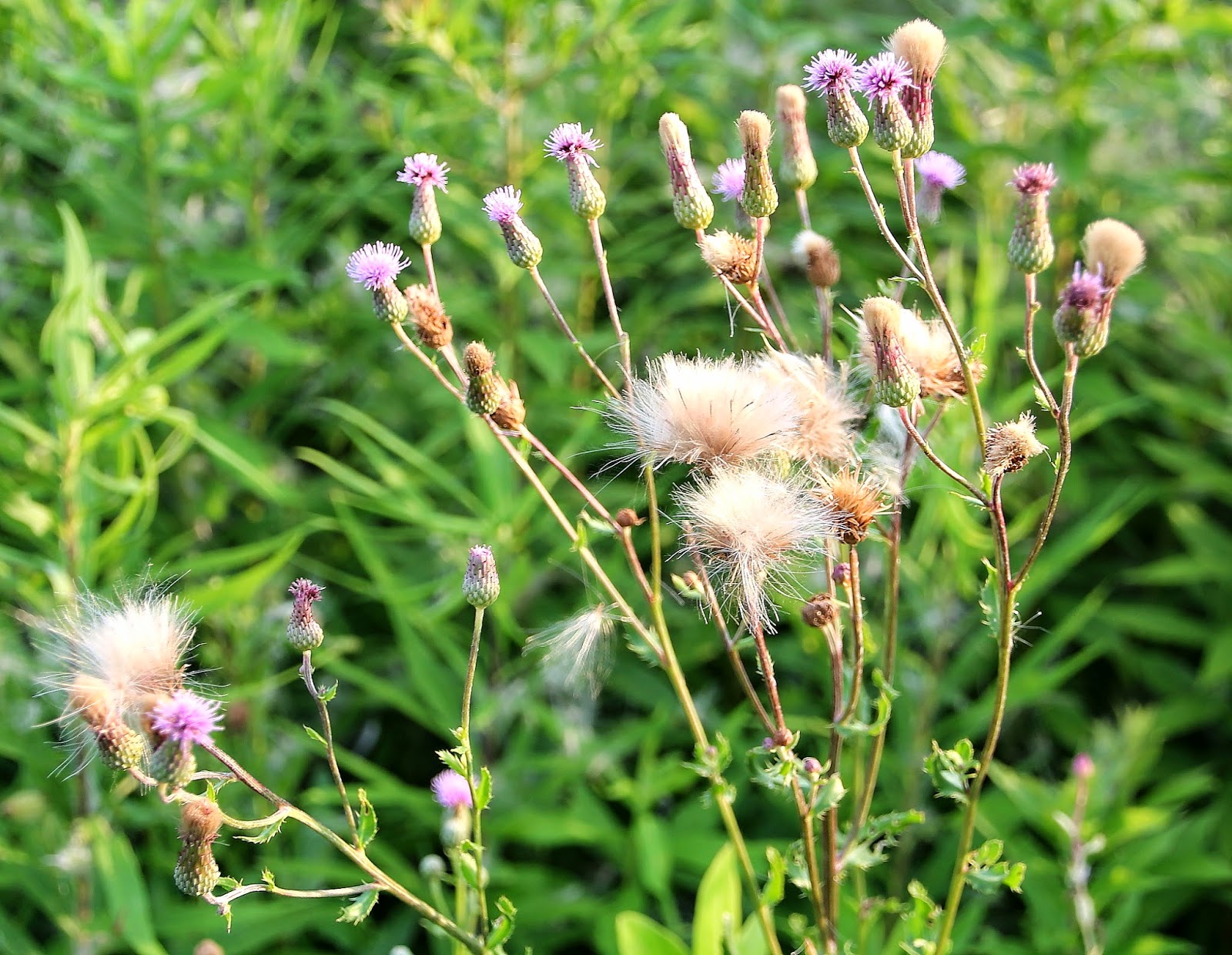
We're experiencing a "snowstorm" in the Pennypack Preserve this month.  Non-native Canada thistle (Cirsium arvense) (a real misnomer and a "slight" to Canada since this thistle is actually a native of Eurasia) has exploded in our grasslands.
The culprit in flower
All stages -  from flower to fluff
The incredible infestation is the result of a perfect storm of unfortunate events.  First, our boom sprayer was out of commission in the spring so Chris Dartley, our grassland manager, couldn't spray the thistle when it was most susceptible.  Second, the herbicide we've been using to try to control the thistle, Transline, seems to be losing its effectiveness, so we're going to have to find an alternative.  And third, by the time we realized the mess we were going to be in, migratory birds and rabbits had begun to nest in the fields, so we couldn't mow the thistle to prevent it from going to seed.
A patch with countless seeds
Non-native wineberry (Rubus phoenicolasis) cloaked in thistledown
Everything in the fields that's not green is thistle
One silver lining to these thistledown clouds: the American Goldfinches (Carduelis tristis) are having a field day (so to speak) feasting on the abundance.

Tuesday, June 3, 2014

Fly Month

This morning, as I was conducting the sixth of the eight forest breeding bird census counts that I do each year in late spring and early summer in Papermill Woods, I noticed my first hoverflies of the year cruising a sunny patch of woodland understory.

Adult hoverflies are a bit intimidating because superficially they resemble wasps or bees.  While the larvae of most species are carnivorous, the adults are exclusively nectar feeders (hence the family's other common name: flowerfly [family Syrphidae]) so I have no reason to be anxious. 

As the forest birds settle into their territories, the forest quiets down quite a bit, providing me opportunities to observe other wildlife like the hoverflies.  This morning, there were four of the flies in the patch.  All were facing the same direction, and they all "hung" in the air, lined up side-by-side about eight inches apart, patrolling their own tiny patch of air space.  Occasionally, one would break ranks for a second, zooming away (usually backwards!) but returning almost instantly to take up exactly as it had left off.  Their world is unfathomable to me, but they are endlessly fascinating to watch.                                                                   
I refer to June as Fly Month. It's the month when mosquitoes make their first appearance and when deer flies are most maddeningly abundant.  Furthermore, I'm no fan of hot weather, so the addition of pestiferous flies to the mix only makes June all the more challenging.  Of course, the forest nesting birds will soon have plenty of new mouths to fill, so perhaps I shouldn't complain about the superabundant dipterans too much. 
 
Submitted by David Robertson
Executive Director

Wednesday, May 14, 2014

Premier Warbler Weekend


Ovenbird (Seiurus aurocapillus) Image courtesy of Audubon
What a great spring weekend!  On Saturday morning, May 10, I accompanied the dedicated group of birders that frequents the Pennypack Preserve for their annual Spring Bird Count.  We were out in the field for 4-1/2 hours, during which time we tallied 65 species (and I got a bit of a sunburn when the sun came out from behind the clouds during the last two hours).  Included in the list were 13 species of warblers; they were the main reason that I went on the bird walk because the warblers are only here for a few days each spring and fall during migration, and I get "rusty" on my identification skills.  The birders all proclaimed this year to be one of the best years for spotting warblers in decades.


A list of the birds we spotted during the Count is posted on the kiosk near the Visitor Center.  The same information can be accessed on the Cornell University Laboratory of Ornithology's e-Bird website.

Actually, my great "weekend" began one day earlier.  As I was scooping birdseed from my storage can in preparation for filling my feeder early on Friday morning, I heard a terrific "thwump" on the window behind me and knew instantly from that sickening sound that a bird had flown into the window.  I thought it was probably one of the Blue Jays that had been at the feeder a minute earlier fleeing from a hawk. But no, it was an Ovenbird, an aberrant warbler that looks like a tiny thrush (see image, above).  Fortunately, the bird was just stunned (and not killed) from the impact, which allowed me to gently lift it off the ground and give it a good inspection - including the orange cap that is almost never visible in the field.  I placed the bird back on the ground and 15 minutes later, when I went outside again, it flew off.

Submitted by
David Robertson, Executive Director


Friday, March 28, 2014

Stocking Up on Trout in the Preserve


Spring is finally here! At least that's what the calendar is saying, but my experience working outdoors tells me another story all together. Either way, we have seasonal spring activities to look forward to: Easter egg hunts, spring wildflowers, the annual Pennypack Creek Clean-up and (my personal favorite) the opening day of trout season. Saturday, March 29, 2014, is the opening day of trout season for 18 southeastern Pennsylvania counties, while the rest of the state will open April 12.
Stocking trout...rather unceremoniously

Across the state all Approved Trout Water streams and lakes have been stocked with farm raised trout. Around Philadelphia we will be fishing for two introduced species: rainbow trout (Oncorhynchus mykiss), native to the Pacific basin (http://en.wikipedia.org/wiki/Rainbow_trout), and brown trout (Salmo trutta), native to Eurasia (http://en.wikipedia.org/wiki/Brown_trout). The waterways around Philadelphia are not appropriate for Pennsylvania’s state fish, the brook trout (Salvelinus fontinalis) (http://en.wikipedia.org/wiki/Brook_trout), due to high water temperatures, unsuitable pH, and competition from non-native fish.
A newly released trout in Pennypack Creek
The section of the Pennypack Creek that runs through the Pennypack Preserve is not public land, so the state Fish and Boat Commission (http://www.fish.state.pa.us/fact_fast_trout.htm) does not stock the creek within the preserve.  Instead, the Trust must rely on volunteers to maintain a fishable trout population. 
Members of Trout Unlimited's Southeastern Montgomery County Chapter
Twice a year Trout Unlimited (TU) Chapter #468 releases 400-500 trout into Pennypack Creek; their most recent release was during the week of March 16. These fish were purchased with private donations and TU membership dues, so please release all trout you catch within the preserve.

Submitted by Gary Snyder
Stewardship Assistant

Monday, March 24, 2014

Field Trip!

Demonstrating the white-tailed deer trap behind the office
Members of the Society for Ecological Restoration's Mid-Atlantic Chapter visited the Pennypack Preserve on Saturday afternoon, March 22, to review forest restoration and white-tailed deer research projects underway here.  This field trip was one of three trips scheduled to coincide with the Chapter's annual conference that took place the day before at Temple University's Ambler Campus.
Dr. Eugene Potapov explaining how he remotely springs the deer trap from his laptop
Dr. Eugene Potapov, a researcher and professor from Bryn Athyn College, began by reviewing the white-tailed deer movement research he and his colleagues have been conducting since 2006 using collared deer and digital telemetry. 
A chapter member from New York City Parks pointing out chestnut blight canker
The group then took a walking tour of The Peak old-growth forest recently cleared of invasive plants, several reforestation projects (including one project that incorporated American chestnut trees, now exhibiting signs of chestnut blight disease), riparian reforestation projects along the Pennypack Creek floodplain, and the 160-acre Raytharn Farm grasslands.  We also took advantage of the fact that one of the tour participants was Dr. James Thorne, a former University of Pennsylvania researcher, who had established a forest succession research project in the preserve in 1990 - a project he had not been back to review in over two decades.

  Dr. James Thorne explaining his research project in the background

Fortunately, the day was partly sunny and warm - the warmest day so far this year, with temperatures in the mid-60s.  I had expected the preserve's trails to be muddy after the endless winter snows, but they were pleasantly firm and dry.  Participants seemed to have enjoyed themselves - even if it was just to have a chance to be outside on a nice spring day.  We even heard spring peepers trilling in Crossroads Marsh!
 
Timing for the tour was fortuitous - there's more snow forecast for tomorrow!

Submitted by:
David Robertson, Executive Director