Tuesday, July 21, 2015

Wait! Wait! Don't Pull Me!


Have you ever seen a vine creeping up on a shrub or tree and thought, “Oh, no you don’t! YANK!” That’s good, right?  Not necessarily. I’m Josh Bruce, a Biology major from Vassar College and long-term resident of the greater Philadelphia area.  As a research intern at the Pennypack Trust this summer I am studying the possibility of unintended environmental damage from well-meaning management practices.
Although invasive vines have become an incredibly destructive force on the East Coast—toppling thousands of acres of forests from the edges inward—combating them with brute force may not be the best strategy. In fact, tearing vines out could lead to greater environmental damage than stability in the long term: tree limbs can be accidentally broken, invasive seeds may be spread, and, most importantly, the forest floor can become disturbed.  Uprooting the shallow root networks of invasive vines largely also clears the ground layer of any plants and tree seedlings that are entangled in the invasive plants' roots, leaving bare patches and, even worse, furrows of loose earth like a tilled garden ready for new seed.

Unfortunately this blank space will either be eroded away or filled by whatever can get there first. Since the area was previously invaded, seeds of that very same invasive plant are likely already in the soil. If the original invasive species doesn’t re-invade, hosts of other invasive species have a chance, and a management area can quickly become a foothold for secondary invasion. The initial invader may have had to contend with a thick layer of dead leaves and a diverse community of native plants when it first tried to invade; the newly "managed" site is left with neither of these defenses; therefore, a secondary invasion will likely be even denser and more successful at suppressing native plant regeneration than the initial invasion.
 With my research this summer I am specifically focusing on Oriental bittersweet (Celastrus orbiculatus). This invasive vine, though hard to pull from trees and shrubs, is relatively easy to pull from the soil, making uprooting a tempting management strategy. I have used a 2-meter-wide, custom designed plot frame (a loop of PVC plumbing pipe) to survey the ground cover vegetation in bittersweet-dense areas in the Pennypack Preserve. This gives me a baseline idea of what an initial bittersweet invasion may look like. Following my survey, I either (1) leave the plot alone, (2) cut the bittersweet stems where they emerge from the ground and clip away as much of the top as possible, or (3) rip all traces of Oriental bittersweet from the plot, along with anything else it might have tangled-up in it.
Next year and for several years thereafter, I (or another young scientist) can go back to these plots, survey what has grown or regrown, and repeat the treatments. After several years I hope to be able to say with confidence whether we should or should not use uprooting as a management strategy for Oriental bittersweet, whether clipping the stems year after year is enough to suitably quell an invasion, and what kind of plants are likely to grow in place of Oriental bittersweet that has been ripped or cut. Until then, cutting and carefully removing the top of invasive vines while leaving the roots intact is the safest, if not the most efficient, way to go.
Submitted by:
Joshua Bruce, Research Intern

Friday, July 10, 2015

Foray to Frazier's Bog

Morton Arboretum's Joe Rothleutner's preparing an herbarium specimen
On Wednesday, July 8, I had the good fortune to escort two horticultural professionals to an amazing wetland located 0.3-mile from the Trust's headquarters - a forested swamp known as Frazier's Bog.

The swamp is not, in fact, a bog.  Bogs are characterized by standing water which is often stained tea-brown by tannins leached from decomposing organic matter.  In addition, bog water is acidic.  Frazier's Bog is actually a fen, which has running (albeit slowly running), clear water that tends to be neutral or slightly basic.  The water at Frazier's Bog seeps out of the porous quartizite bedrock Edge Hill Ridge immediately to the north, and the shallow rills, runnels, and rivulets that thread through the wetland flow over sandy beds.

The swamp is also amazing because it's a Coastal Plain outlier.  The Pennypack Preserve and environs are on the solid, metamorphic rocky Piedmont; the edge of the sandy Coastal Plain lies about 10 miles to the south.  Nevertheless, many of the the plants that occur in Frazier's Bog are plants typical of the Coastal Plain in New Jersey, not the Piedmont.  So, Frazier's bog is a rarit y- an island of the Coastal Plain 250 feet above sea level in a shallow basin in the Piedmont. 

The bog's unusual nature has been recognized for a century and a half, and over the years countless botanic field trips have tromped through the spongy, saturated site.  Currently, the wetland is located at the edge of the second fairway of Huntingdon Valley Country Club's C-golf course, but fortunately the country club recognizes the botanic gem and has posted signs to keep golfers out of the swamp (which is a treasure trove of lost golf balls).
Fortunately, the country club recognizes the wetland's value
Frazier's Bog (and and only two other sites in Pennsylvania) support sweetbay magnolia trees (Magnolia virginiana).  The Morton Arboretum in Lisle, Illinois and the Chicago Botanic Garden (CBG) have joined forces to create a sweetbay magnolia collection that includes specimens from the full range of the tree - Massachusetts to Cuba.  On Tuesday, Andrew Bunting of CBG and Joe Rothleutner of the Morton Arboretum came to Frazier's Bog to take softwood cuttings from 10 magnolias growing in the swamp.  They will attempt to root the specimens so they can be planted in the botanic gardens, and so that they can be propagated and shared with other gardens.  In addition, they are creating a germplasm "bank" in case the sites where these trees occur naturally are eliminated by hurricanes, tornadoes, fire or development. 
 Chicago Botanic Garden's Andrew Bunting "bagging" his quarry
The swamp floor is carpeted with skunk cabbage and ferns
In addition to taking the softwood cuttings, the pair collected specimens of the leaves and fruit from each of the sampled trees to include in an herbarium collection.
The Dynamic Duo just before leaving the swamp
After we left the swamp, we crossed to the opposite side of the fairway (fore!) to check on another Coastal Plain species, netted chain fern (Woodwardia areolata).
Joe photographing netted chain fern
When the country club resurrected this 9-hole course about 20 years ago (it had been "abandoned" during the Great Depression), they had enclosed the stand of ferns inside orange construction fencing.  The construction fencing is long gone and has been replaced with unobtrusive wire mesh fencing (which is collapsed and useless); the ferns, nonetheless, are thriving.
 
Submitted by
David Robertson, Executive Director

Dog Vomit Slime

Now that I've got your attention...
On the wood-chipped path outside my office
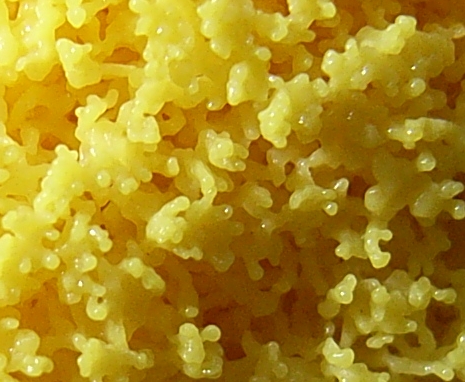
Of late, I'm obsessed with slime mold, and one species in particular: Fuligo septica.  Last year, a neighbor cut down several large tuliptrees that had grown too near his house.  His arborist chipped the wood, and Pennypack took the wood chips for our trails.  This spring, the wood chipped trail has come alive repeatedly with slime mold aggregations.

At first, this slime mold is a strikingly bright, brilliant yellow.

Image from Wikipedia
But after a day or so, it turns dun-colored and looks like its common name.

When I saw it, I knew this organism was a slime mold, but I knew very little about it, so I checked out the citation on Wikipedia and found out that Dog Vomit Slime (also known in more genteel circles as Scrambled Egg Slime [still not too appetizing] or Flowers of Tan) is one of the most common and widely distributed of the slime molds.

Slime molds are not molds (i.e., fungus) at all despite their common name. They and the other protists (i.e., single celled organisms) are lumped into their own kingdom equivalent to the animals, plants, and fungi, but the classification is constantly in flux because the relationships among these organisms are so poorly known and understood.
Like many slime molds, the cells of this species typically live independently, then based on some unknown cue, they come together and aggregate to form a plasmodium. Each cell gives up its individual existence and merges its cell body and nucleus into a mass that may move in an amoeba-like fashion in search of nutrients. F. septica's plasmodium may range from white to yellow-gray, and is typically 1-8 inches in diameter and 0.4–1.2 inches thick. The plasmodium eventually transforms into a sponge-like aethalium, analogous to the spore-bearing fruiting body of a mushroom, which then degrades, darkens in color, and releases its dark-colored spores. F. septica produces the largest aethalium of any slime mold.
Close-up image of the aethalium.  Soo cool!
In Estonian mythology, the aethalium was thought to be the leftovers from a kratt, a creature created by farmers out of hay and/or farm implements, given life by the devil after the farmer surrendered three drops of blood, and obligated to do the farmer's bidding. F. septica in Finland was believed to be used by witches to spoil their neighbors' milk. This gives it the name paranvoi, meaning "butter of the familiar spirit." In Flemish, it is known as "heksenboter," which refers to "witch's butter."
What strikes me as most odd is that none of the myriad visitors to the Trust's office who walk past the slime molds ever come in to inquire about them, especially when they're in their bright yellow stage.
 
Submitted by
David Robertson, Executive Director

Wednesday, July 1, 2015

Feodor Pitcairn's Iceland Revealed Exhibit at Smithsonian

A Smithsonian staff member in the hall outside Iceland Revealed exhibit
Pennypack's founder Feodor Pitcairn is a very accomplished nature photographer.  Though he worked in his family's financial business, his true love was photography.  He began his photographic career making stunning, natural-light undersea still images, then graduated to undersea videography. 

At 80 years old, he has forsaken diving (too dangerous, he claims; he has related some really "close calls").  Now he photographs terrestrial landscapes with high definition equipment.  He has spent the last several years making expeditions to Iceland, which has resulted in an exhibition of his work at the Smithsonian Institution's National Museum of Natural History in Washington opening on July 2, 2015.

Mr. Pitcairn collaborated with Icelandic poet Ari Trausti Guðmundsson to "reveal a land of fire, ice, hardy life, and natural beauty. Visitors to the exhibit experience the remote beauty of Iceland, a land sculpted by the elements and forged by active geologic activity."
Enjoying the exhibit
Mr. Pitcairn organized a bus tour to Washington for a group of his friends for the exhibit's opening on June 30, and my wife Mary and I were invited to come along.  It was the culmination of years of work, and he was in "seventh heaven."
A beaming Mr. Pitcairn
A well-known Icelandic folk troupe with the (translated) name "Seasons" happened to be in town on tour and entertained the crowd during the reception.  During the mingling after the formal speechifying, Mary and I had a chance to speak with the Icelandic Ambassador to the United States and former Icelandic Prime Minister Geir H. Haarde.  He gave us his card and invited us to contact him if we wanted some "special considerations" should we choose to visit Iceland.

Though Mr. Pitcairn's images are striking, Mary's not much motivated by stark, sere landscapes.  I doubt we'll take Mr. Haarde up on his offer.

Mr. Pitcairn has also published an art book of his Icelandic images.  Pennypack can obtain copies for anyone interested in buying the book.

Submitted by David Robertson
Executive Director   

Saturday, June 13, 2015

Bethayres Swamp Slog

One hundred forty years ago, an intense corporate rivalry inadvertently produced the largest wetland in Montgomery County, located just a quarter-mile south of the Pennypack Preserve.  In the mid-1870s, the Pennsylvania Railroad and Reading Railroad each were desperate to build a railroad linking Philadelphia to New York City.  The Pennsylvania Railroad chose a route that was slightly longer but which incorporated a straightaway that ran level and flat for dozens of miles along the Huntingdon Valley geological fault.  The Reading Railroad selected a shorter, more direct route that used the water gap eroded by Pennypack Creek to penetrate the high, steep northern face of the geologic fault at Welsh Road.  Each railroad company had to place tremendous quantities of fill in the wide floodplain of the creek in order to raise its tracks out of the floodplain, and this fill, in turn, impeded drainage toward the creek, thereby impounding the 40-acre Bethayres Swamp with which we are blessed today.
Field trip participants on the former Reading Railroad bridge over the swamp drainage channel
Because the wetland includes habitat that is unusual in southeastern Pennsylvania, the Philadelphia Botanic Club scheduled a field trip to visit the site on Saturday morning, June 6, and they asked me to come along for the walk.  Though I have walked in the wetland proper a few times, I usually stick to the railroad tracks when I explore.  The Reading Railroad tracks have been removed and are now part of the county's Pennypack Trail; the Pennsylvania Railroad tracks are still in use for commuter rail service on the West Trenton line.

Making our way down from the railroad bed to the marsh
The water in the wetland is deepest near the rail lines, then the land gradually slopes upward and becomes drier as the distance from the tracks increases.  Nearest the tracks, the wetland is a marsh with dense emergent herbaceous vegetation.  Further uphill, the vegetation grades to shrub-swamp.  And, in the driest areas, the wetland becomes a red maple-pin oak (Acer rubrum-Quercus palustris) swamp forest.  Our group of seven walkers at first scoped-out the wetland from the elevated railroad tracks, and then skidded down the embankment and "took the plunge" into the jungle led by yours truly, who got tired of just poking around the edge.  Fortunately (for the hike), we hadn't had much rain lately, so the wetland had little standing water and just a few inches of organic ooze.
Let the botanizing begin!
Almost immediately, we came across a pair of Eastern Box Turtles (Terrapene carolina carolina) in flagrante delicto; alas, they disengaged immediately.
The female half of an Easter Box Turtle pair
Further into the marsh, we found a nest likely built by Red-winged Blackbirds (Agelaius phoeniceus) last summer suspended between a few twigs .
Last year's nest, probably from a Red-winged Blackbird
An abundance of sedges (very challenging to identify)
Field trip leader Joe serving as a backdrop for pictures of a blooming sedge
One of the plants we were especially interested in finding was lizard's-tail (Saururus cernuus).  It's not that rare, but it's an interesting wetland obligate that's not extraordinarily common.  I was the first to come across the plant, but as we continued across the marsh we found huge expanses of the plant.
Our quarry:  Lizard's-tail (Saururus cernuus)
One of my favorite plants: parasitic dodder (Cuscuta spp.) (the orange "silly string")  How cool is that?
We finally emerged from the marsh and shrub-swamp into the drier swamp forest.  Here, there's no understory to impede walking because the large deer herd that finds refuge in this isolated pocket of wilderness eats most regenerating trees and shrubs.
Pin oak-red maple swamp forest in the driest parts of the swamp
Honestly, I wasn't looking forward to participating in this walk.  It was on a Saturday morning after I had just worked a full week, and it involved a trudge through mud and extremely dense vegetation (think African Queen here).  But, you know what?  I had a great time!  I got wet and muddy and the participants were enthusiastic.  When I got back home and told my wife about my morning, she said, "Despite your belly-aching, I knew you'd have a great time!"  She knows me better than I know myself.

Submitted by David Robertson
Executive Director

Thursday, October 30, 2014

Reassessing the Raytharn Farm Grasslands

Between a pasture and a crop circle
Since 1997, the Pennypack Trust has been working diligently to create habitat for meadow-nesting birds which, as a group, are the most endangered suite of birds on the East Coast because of habitat loss.  Our strategy has been to establish native, warm-season grasses on the 160-acre Raytharn Farm we purchased that year.  Now nearly two decades into the project, we have a fairly respectable stand of native "prairie" grasses cloaking the land.  The grasses are beautiful (especially this time of year), resilient, and very popular with our visitors - but not with the birds we are trying to attract.  Eastern Meadowlarks, Bobolinks, and several species of sparrows stop in the grasslands during migration, but they never stay to breed.  What's wrong?  Didn't we do everything right?

Well, it turns out we didn't do everything right.  Grassland managers all along the East Coast have come to realize that the birds are seeking diversity - diversity in height and diversity in plant composition.  To the birds, our grasslands are too dense, too tall, and too monotonous, and they don't provide food (i.e., insects) in sufficient quantities for nestlings.

So, you might recommend that we diversify the grasslands, and you'd be right.  However, we also have a terrible problem with invasive plants.  The grasses can be treated with special herbicides that kill all invasive plants except the grasses, but there's no such "magic bullet" for diverse combinations of plants.  Once invasive plants colonize a mixed-vegetation meadow, control becomes much more time consuming and costly because the invasive plants have to be removed "surgically" without disturbing the desirable plants.  We've resisted trying to diversify our grasslands for that reason.

But, we've finally come to the realization that (1) we're not going to attract meadow-nesting birds if we don't do something different, and (2) if we can't attract meadow-nesting birds, why have the grasses at all because our landscape really wants to be a forest and we have to fight Mother Nature (i.e., natural succession) to keep it in grassland.

Fortuitously, I recently ran into Roger Latham, a respected field ecologist.  Roger and I are good friends, and he has visited Pennypack to consult on several occasions.  He also served on the board of directors of the Natural Lands Trust (NLT), which has preserves all over southeastern Pennsylvania and southern New Jersey.  He told me that NLT's Gwynedd Wildlife Preserve near Ambler had had Eastern Meadowlarks nesting in its native grasslands this summer, and he suggested that I talk to Gwynedd's land manager for some guidance.  So, I rounded-up Pennypack's senior stewardship staff for a field trip and we paid a visit to Gwynedd on October 30.  
Edge of the "crop circle" (darker foreground), native grassland (tawny center) and pasture (green, far left)
Tom, Gwynedd 's land manager had successfully created native grasslands like we had, but had also failed to attract meadow-nesting birds.  Then, he decided to create "crop circles" - round meadows within the grasslands that he seeded with a mixture of 16 different species of low-growing flowering plants (i.e., wildflowers).  Three years ago, he established about 10 such circles ranging in size from 0.25-acre to over 4 acres.  And, this summer, Eastern Meadowlarks nested in his preserve - not in the crop circles (and not in the native grasses), but in a pasture composed of non-native grasses immediately adjacent to the largest crop circle.  
Diverse crop circle vegetation (foreground)
Tom watched the meadowlarks build nests in the pasture (which is just as monotonous a monoculture as the native grasslands, but lower in height).  Then he watched the adult birds fly into the crop circle to catch insects that were using the wildflowers.  Success!
Crop circle (foreground), native grasslands (mid-ground), and woodland (background)
Tom's crop circles get colonized by the same invasive plant species with which we have to contend, but he told us that he is able to control the invasives before they become problematic with a combination of mowing before the invaders set seed, spot application of herbicide, and the judicious use of a string trimmer.  He's got a smaller land stewardship staff than Pennypack does, so Pennypack's staff should be able to do as well.
Crop circle (right) and native grassland (left)
Pennypack's staff drew-up plans for the Raytharn Farm grassland modifications in the car on the way back to Pennypack.  Stay tuned; it may be a year or two before we're successful, but at least we now have a plan!
 
Autumn color in the Gwynedd grasslands
 Submitted by David Robertson
 Executive Director

Wednesday, October 15, 2014

Moon of Falling Leaves Ramble


All eyes (image borrowed from an Internet source)
The sky cooperated beautifully for our postponed-because-of-rain Full Moon Walk on the evening of Wednesday, October 8, giving 15 walkers great views of the moon and some interesting checkered patterns created by the subtly illuminated clouds.  Also, while it was a bit breezy, the temperature was perfect for the walk - mid 60s.

As I was leaving the office for the day a few hours before the walk, I mentioned to a co-worked that I had to lead the walk and that I'd have to make sure that none of the walkers tripped in a groundhog hole in the dark.  Well, none of the walkers fell into a hole, but honest to goodness, I did, and I went down on my back.  Boy, did I feel stupid, but nothing other than my pride was hurt.

In an effort to spot something during the walk, I shined my strong flashlight into some of the meadows alongside the trail on Raytharn Farm.  No deer, coyotes, or foxes, but the light did reflect off a tiny "something" in the grass.  It was a pinprick of brilliant green light.  I left the trail, keeping the light shining on my "quarry" all the while.  When I got right up to the spot, the reflection disappeared (the angle of the light had shifted so the pinprick was no longer reflecting anything).  I searched and searched, but couldn't see anything until I finally spotted a wolf spider among the grass.  Sure enough, its eye(s) were reflecting green.  Cool!  After I spotted the first spider, we started to see them everywhere.

Near the end of the walk, I shined my light into an open meadow often favored by deer.  We saw two green eyes burning back at us.  The eyes blinked, and then whatever it was walked away.  The eyes were forward-facing; I suspect they were a fox or coyote rather than a deer.


Everyone seemed satisfied by the walk even though we didn't see any animals (we're too noisy), hear any owls, or observe any constellations because the sky was too bright from the reflected lights of the city.  Most people just seemed to enjoy the light of the moon reflected like quicksilver on Pennypack Creek  and walking outside creating their own moon shadows.

Submitted by David Robertson
Executive Director