Saturday, June 13, 2015

Bethayres Swamp Slog

One hundred forty years ago, an intense corporate rivalry inadvertently produced the largest wetland in Montgomery County, located just a quarter-mile south of the Pennypack Preserve.  In the mid-1870s, the Pennsylvania Railroad and Reading Railroad each were desperate to build a railroad linking Philadelphia to New York City.  The Pennsylvania Railroad chose a route that was slightly longer but which incorporated a straightaway that ran level and flat for dozens of miles along the Huntingdon Valley geological fault.  The Reading Railroad selected a shorter, more direct route that used the water gap eroded by Pennypack Creek to penetrate the high, steep northern face of the geologic fault at Welsh Road.  Each railroad company had to place tremendous quantities of fill in the wide floodplain of the creek in order to raise its tracks out of the floodplain, and this fill, in turn, impeded drainage toward the creek, thereby impounding the 40-acre Bethayres Swamp with which we are blessed today.
Field trip participants on the former Reading Railroad bridge over the swamp drainage channel
Because the wetland includes habitat that is unusual in southeastern Pennsylvania, the Philadelphia Botanic Club scheduled a field trip to visit the site on Saturday morning, June 6, and they asked me to come along for the walk.  Though I have walked in the wetland proper a few times, I usually stick to the railroad tracks when I explore.  The Reading Railroad tracks have been removed and are now part of the county's Pennypack Trail; the Pennsylvania Railroad tracks are still in use for commuter rail service on the West Trenton line.

Making our way down from the railroad bed to the marsh
The water in the wetland is deepest near the rail lines, then the land gradually slopes upward and becomes drier as the distance from the tracks increases.  Nearest the tracks, the wetland is a marsh with dense emergent herbaceous vegetation.  Further uphill, the vegetation grades to shrub-swamp.  And, in the driest areas, the wetland becomes a red maple-pin oak (Acer rubrum-Quercus palustris) swamp forest.  Our group of seven walkers at first scoped-out the wetland from the elevated railroad tracks, and then skidded down the embankment and "took the plunge" into the jungle led by yours truly, who got tired of just poking around the edge.  Fortunately (for the hike), we hadn't had much rain lately, so the wetland had little standing water and just a few inches of organic ooze.
Let the botanizing begin!
Almost immediately, we came across a pair of Eastern Box Turtles (Terrapene carolina carolina) in flagrante delicto; alas, they disengaged immediately.
The female half of an Easter Box Turtle pair
Further into the marsh, we found a nest likely built by Red-winged Blackbirds (Agelaius phoeniceus) last summer suspended between a few twigs .
Last year's nest, probably from a Red-winged Blackbird
An abundance of sedges (very challenging to identify)
Field trip leader Joe serving as a backdrop for pictures of a blooming sedge
One of the plants we were especially interested in finding was lizard's-tail (Saururus cernuus).  It's not that rare, but it's an interesting wetland obligate that's not extraordinarily common.  I was the first to come across the plant, but as we continued across the marsh we found huge expanses of the plant.
Our quarry:  Lizard's-tail (Saururus cernuus)
One of my favorite plants: parasitic dodder (Cuscuta spp.) (the orange "silly string")  How cool is that?
We finally emerged from the marsh and shrub-swamp into the drier swamp forest.  Here, there's no understory to impede walking because the large deer herd that finds refuge in this isolated pocket of wilderness eats most regenerating trees and shrubs.
Pin oak-red maple swamp forest in the driest parts of the swamp
Honestly, I wasn't looking forward to participating in this walk.  It was on a Saturday morning after I had just worked a full week, and it involved a trudge through mud and extremely dense vegetation (think African Queen here).  But, you know what?  I had a great time!  I got wet and muddy and the participants were enthusiastic.  When I got back home and told my wife about my morning, she said, "Despite your belly-aching, I knew you'd have a great time!"  She knows me better than I know myself.

Submitted by David Robertson
Executive Director

Thursday, October 30, 2014

Reassessing the Raytharn Farm Grasslands

Between a pasture and a crop circle
Since 1997, the Pennypack Trust has been working diligently to create habitat for meadow-nesting birds which, as a group, are the most endangered suite of birds on the East Coast because of habitat loss.  Our strategy has been to establish native, warm-season grasses on the 160-acre Raytharn Farm we purchased that year.  Now nearly two decades into the project, we have a fairly respectable stand of native "prairie" grasses cloaking the land.  The grasses are beautiful (especially this time of year), resilient, and very popular with our visitors - but not with the birds we are trying to attract.  Eastern Meadowlarks, Bobolinks, and several species of sparrows stop in the grasslands during migration, but they never stay to breed.  What's wrong?  Didn't we do everything right?

Well, it turns out we didn't do everything right.  Grassland managers all along the East Coast have come to realize that the birds are seeking diversity - diversity in height and diversity in plant composition.  To the birds, our grasslands are too dense, too tall, and too monotonous, and they don't provide food (i.e., insects) in sufficient quantities for nestlings.

So, you might recommend that we diversify the grasslands, and you'd be right.  However, we also have a terrible problem with invasive plants.  The grasses can be treated with special herbicides that kill all invasive plants except the grasses, but there's no such "magic bullet" for diverse combinations of plants.  Once invasive plants colonize a mixed-vegetation meadow, control becomes much more time consuming and costly because the invasive plants have to be removed "surgically" without disturbing the desirable plants.  We've resisted trying to diversify our grasslands for that reason.

But, we've finally come to the realization that (1) we're not going to attract meadow-nesting birds if we don't do something different, and (2) if we can't attract meadow-nesting birds, why have the grasses at all because our landscape really wants to be a forest and we have to fight Mother Nature (i.e., natural succession) to keep it in grassland.

Fortuitously, I recently ran into Roger Latham, a respected field ecologist.  Roger and I are good friends, and he has visited Pennypack to consult on several occasions.  He also served on the board of directors of the Natural Lands Trust (NLT), which has preserves all over southeastern Pennsylvania and southern New Jersey.  He told me that NLT's Gwynedd Wildlife Preserve near Ambler had had Eastern Meadowlarks nesting in its native grasslands this summer, and he suggested that I talk to Gwynedd's land manager for some guidance.  So, I rounded-up Pennypack's senior stewardship staff for a field trip and we paid a visit to Gwynedd on October 30.  
Edge of the "crop circle" (darker foreground), native grassland (tawny center) and pasture (green, far left)
Tom, Gwynedd 's land manager had successfully created native grasslands like we had, but had also failed to attract meadow-nesting birds.  Then, he decided to create "crop circles" - round meadows within the grasslands that he seeded with a mixture of 16 different species of low-growing flowering plants (i.e., wildflowers).  Three years ago, he established about 10 such circles ranging in size from 0.25-acre to over 4 acres.  And, this summer, Eastern Meadowlarks nested in his preserve - not in the crop circles (and not in the native grasses), but in a pasture composed of non-native grasses immediately adjacent to the largest crop circle.  
Diverse crop circle vegetation (foreground)
Tom watched the meadowlarks build nests in the pasture (which is just as monotonous a monoculture as the native grasslands, but lower in height).  Then he watched the adult birds fly into the crop circle to catch insects that were using the wildflowers.  Success!
Crop circle (foreground), native grasslands (mid-ground), and woodland (background)
Tom's crop circles get colonized by the same invasive plant species with which we have to contend, but he told us that he is able to control the invasives before they become problematic with a combination of mowing before the invaders set seed, spot application of herbicide, and the judicious use of a string trimmer.  He's got a smaller land stewardship staff than Pennypack does, so Pennypack's staff should be able to do as well.
Crop circle (right) and native grassland (left)
Pennypack's staff drew-up plans for the Raytharn Farm grassland modifications in the car on the way back to Pennypack.  Stay tuned; it may be a year or two before we're successful, but at least we now have a plan!
 
Autumn color in the Gwynedd grasslands
 Submitted by David Robertson
 Executive Director

Wednesday, October 15, 2014

Moon of Falling Leaves Ramble


All eyes (image borrowed from an Internet source)
The sky cooperated beautifully for our postponed-because-of-rain Full Moon Walk on the evening of Wednesday, October 8, giving 15 walkers great views of the moon and some interesting checkered patterns created by the subtly illuminated clouds.  Also, while it was a bit breezy, the temperature was perfect for the walk - mid 60s.

As I was leaving the office for the day a few hours before the walk, I mentioned to a co-worked that I had to lead the walk and that I'd have to make sure that none of the walkers tripped in a groundhog hole in the dark.  Well, none of the walkers fell into a hole, but honest to goodness, I did, and I went down on my back.  Boy, did I feel stupid, but nothing other than my pride was hurt.

In an effort to spot something during the walk, I shined my strong flashlight into some of the meadows alongside the trail on Raytharn Farm.  No deer, coyotes, or foxes, but the light did reflect off a tiny "something" in the grass.  It was a pinprick of brilliant green light.  I left the trail, keeping the light shining on my "quarry" all the while.  When I got right up to the spot, the reflection disappeared (the angle of the light had shifted so the pinprick was no longer reflecting anything).  I searched and searched, but couldn't see anything until I finally spotted a wolf spider among the grass.  Sure enough, its eye(s) were reflecting green.  Cool!  After I spotted the first spider, we started to see them everywhere.

Near the end of the walk, I shined my light into an open meadow often favored by deer.  We saw two green eyes burning back at us.  The eyes blinked, and then whatever it was walked away.  The eyes were forward-facing; I suspect they were a fox or coyote rather than a deer.


Everyone seemed satisfied by the walk even though we didn't see any animals (we're too noisy), hear any owls, or observe any constellations because the sky was too bright from the reflected lights of the city.  Most people just seemed to enjoy the light of the moon reflected like quicksilver on Pennypack Creek  and walking outside creating their own moon shadows.

Submitted by David Robertson
Executive Director

Tuesday, September 23, 2014

Sora Out of Water

Sora (Porzana carolina) [Image from an Internet source]
This morning, two of Pennypack's best birders and nature photographers, Harris Brown and Fran Ventura, stopped in the office after a morning photo shoot to report that they had found and rescued a Sora (Porzana carolina) on a trail through the tall native grasslands on Raytharn Farm.  The Sora (a type of rail) was alive (though clearly injured or sick); Harris and Fran planned to take it to the Aark wildlife rehabilitation facility in Chalfont to see if it could be saved.

Two years ago, Pennypack birder Michael Grubb found a Sora on another of the Raytharn Farm grassland trails, but that bird was dead. 

I have no idea why a fairly uncommon bird almost always associated with marshes would be found high and dry in the prairie-like grasslands we have established in parts of the Pennypack Preserve.  Nor do I have any idea why these birds are in bad shape.  It's great that they're here, but not if the preserve is acting as a "sink" in which the birds fall victim to predators or disease.
 
Posted by David Robertson
Executive Director 

Thursday, August 28, 2014

Pennypack Trail Reconnoiter

Traversing a trestle spanning Pennypack Creek at Bethayres Woods
Visitors to the Pennypack Preserve know that the suspended Fox Chase-Newtown railroad right-of-way bisects the preserve, roughly paralleling Pennypack Creek that also bisects the preserve.  The rail line was built in 1876 with the intention of linking Philadelphia to New York City.  But a second rail line (the West Trenton line), built two years earlier in 1874, also with the intention of linking Philadelphia to New York City, had the advantage of traversing flatter terrain and allowing for greater speeds.  As a result, the 1874 line (built by the Pennsylvania Railroad) quickly won out, and the line through the Pennypack Preserve (built by the Reading Railroad) was extended northward from Philadelphia only about 30 miles to Newtown in Bucks County and served local commuters.

The line was carrying passengers until 1984, when SEPTA suspended service because of low ridership.  When service stopped, SEPTA abandoned the right-of-way, which mostly became overgrown with vegetation.  Walkers kept a casual trail open along the right-of-way by wearing a path, but the edges of the rail line became a jungle.

Then, Montgomery County decided that it was going to turn the right-of-way into a trail.  They began by removing the rails and ties along the 2-mile section of the right-of-way that ran through Lorimer Park, a county park downstream.  Now, the county is extending the trail northward through the Pennypack Preserve.  The trail will be complete by next summer (2015).  We're concerned that mountain bicyclists and dog walkers will ignore the trail use limitations in the Pennypack Preserve.  On the other hand, the secluded rail corridor had been a site for vandalism, drinking and drug use, so the trial could have some positive impacts, too.

On Wednesday morning, August 27, a group of people from the county, two local municipalities, and the Pennypack Trust walked the length of the new trail route to point out areas where we anticipate there could be problems so that the county could plan accordingly.  Here are some images from our walk.
The trail route through Bethayres Woods
Estimating the width of the final trail
Purple loosestrife (Lythrum slicaria) and rose-mallow (Hibiscus moscheutos) along the trail
Approaching the Bryn Athyn post office/train station
Pennypack Creek just upstream from the post office
Crossing another trestle over Pennypack Creek (there are three trestles in the preserve).  House on the right is private.
Pennypack Creek viewed upstream from the trestle, above
A green tunnel
The historic stone-arch Creek Road bridge over the Pennypack, now part of our trail system.  This is the second-oldest bridge in Montgomery County (1840).

Thursday, July 17, 2014

Summer Snowstorm

Look carefully for the "snowflakes" against the dark trees in the background
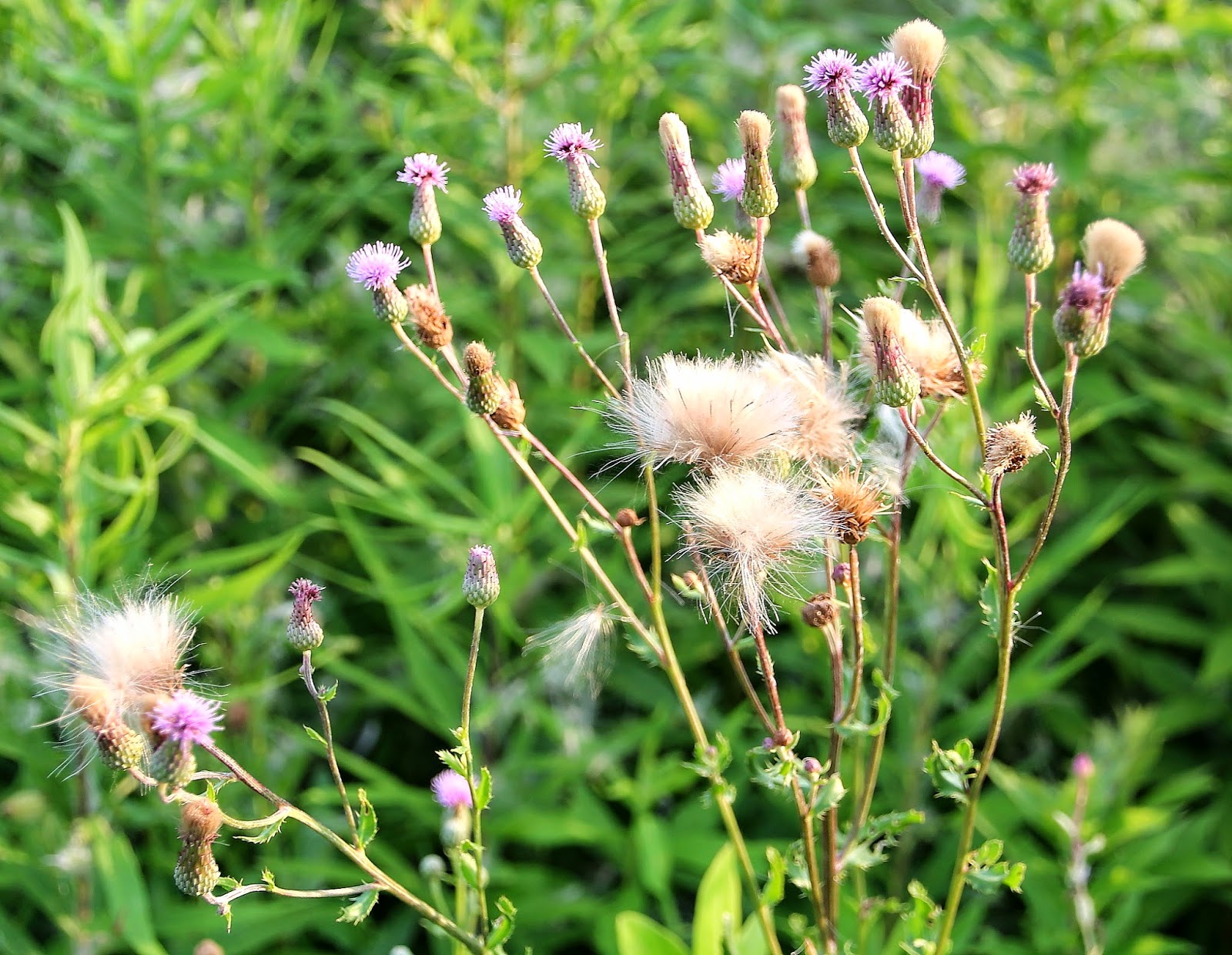
We're experiencing a "snowstorm" in the Pennypack Preserve this month.  Non-native Canada thistle (Cirsium arvense) (a real misnomer and a "slight" to Canada since this thistle is actually a native of Eurasia) has exploded in our grasslands.
The culprit in flower
All stages -  from flower to fluff
The incredible infestation is the result of a perfect storm of unfortunate events.  First, our boom sprayer was out of commission in the spring so Chris Dartley, our grassland manager, couldn't spray the thistle when it was most susceptible.  Second, the herbicide we've been using to try to control the thistle, Transline, seems to be losing its effectiveness, so we're going to have to find an alternative.  And third, by the time we realized the mess we were going to be in, migratory birds and rabbits had begun to nest in the fields, so we couldn't mow the thistle to prevent it from going to seed.
A patch with countless seeds
Non-native wineberry (Rubus phoenicolasis) cloaked in thistledown
Everything in the fields that's not green is thistle
One silver lining to these thistledown clouds: the American Goldfinches (Carduelis tristis) are having a field day (so to speak) feasting on the abundance.

Tuesday, June 3, 2014

Fly Month

This morning, as I was conducting the sixth of the eight forest breeding bird census counts that I do each year in late spring and early summer in Papermill Woods, I noticed my first hoverflies of the year cruising a sunny patch of woodland understory.

Adult hoverflies are a bit intimidating because superficially they resemble wasps or bees.  While the larvae of most species are carnivorous, the adults are exclusively nectar feeders (hence the family's other common name: flowerfly [family Syrphidae]) so I have no reason to be anxious. 

As the forest birds settle into their territories, the forest quiets down quite a bit, providing me opportunities to observe other wildlife like the hoverflies.  This morning, there were four of the flies in the patch.  All were facing the same direction, and they all "hung" in the air, lined up side-by-side about eight inches apart, patrolling their own tiny patch of air space.  Occasionally, one would break ranks for a second, zooming away (usually backwards!) but returning almost instantly to take up exactly as it had left off.  Their world is unfathomable to me, but they are endlessly fascinating to watch.                                                                   
I refer to June as Fly Month. It's the month when mosquitoes make their first appearance and when deer flies are most maddeningly abundant.  Furthermore, I'm no fan of hot weather, so the addition of pestiferous flies to the mix only makes June all the more challenging.  Of course, the forest nesting birds will soon have plenty of new mouths to fill, so perhaps I shouldn't complain about the superabundant dipterans too much. 
 
Submitted by David Robertson
Executive Director